
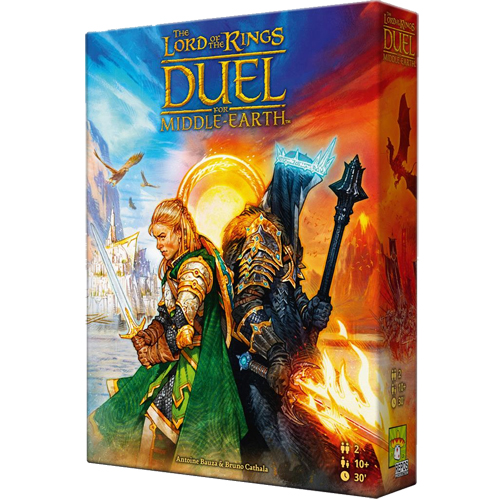
When I first heard about The Lord of the Rings: Duel for Middle-earth, I assumed it would mostly be a reskin of 7 Wonders Duel. And honestly, I would have been fine with that. 7 Wonders Duel is already a solid two-player game. But after playing Duel for Middle-earth several times, I realized it does more than just change the theme. It keeps the familiar foundation while adding some clever ideas that make the experience feel fresh.
What surprised me most is how naturally the Lord of the Rings theme fits into the gameplay. It does not feel like a theme pasted on top of existing mechanics. During a few matches, I actually felt the tension of the journey to Mordor or the pressure of defending Middle-earth. Those moments made the game feel very thematic in a simple but effective way.
The Core Idea of the Game
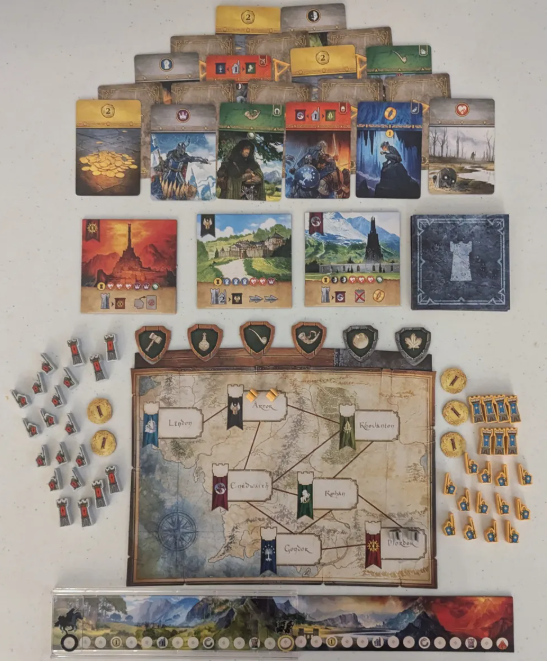
At its heart, Duel for Middle-earth is a focused two-player strategy game that usually takes about thirty to forty minutes. One player represents the Fellowship trying to move the One Ring toward Mount Doom. The other player controls the forces of Sauron and tries to stop them.
I really like how the game keeps both players involved the whole time. Every turn feels meaningful, and I often find myself thinking carefully before picking a card. Because there are multiple ways to win, I never feel comfortable ignoring what my opponent is doing.
Three Different Ways to Win
One of the most exciting parts of the game is that it offers three different instant victory paths. Instead of slowly adding up points at the end, the game can end suddenly if someone completes one of these objectives.
The first is the Quest of the Ring. Certain cards move Frodo and Sam along a track toward Mordor, while the Nazgûl chase them from behind. In a couple of my games, this track became the center of the tension. Watching the gap between the characters shrink created some really dramatic turns.
The second path is gaining support from the different races of Middle-earth. If a player collects all six race tokens, they win immediately. I learned quickly that I cannot ignore this path. Even when I focus on something else, I still keep checking which races my opponent is collecting.
The third path involves controlling regions on the map of Middle-earth. If someone manages to dominate the entire map, the game ends instantly. What I enjoy here is how the three victory conditions constantly overlap. While I am pushing one strategy, I am always watching the other two.
The Map Adds New Strategy
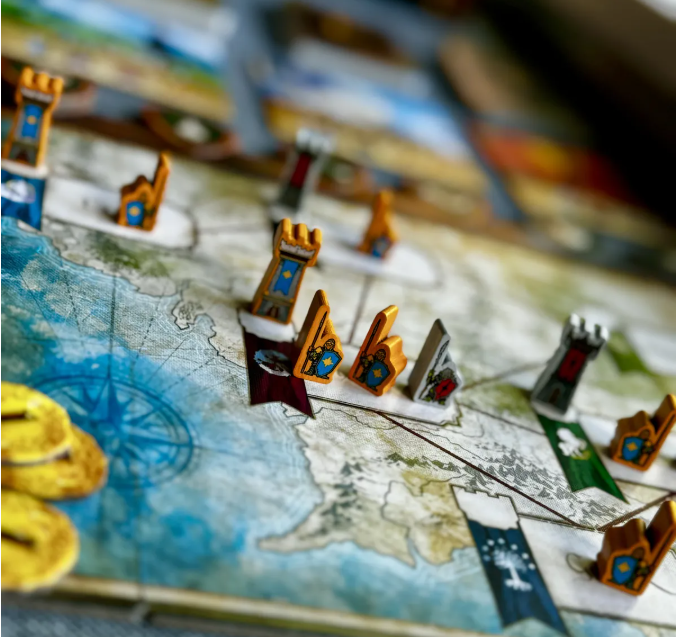
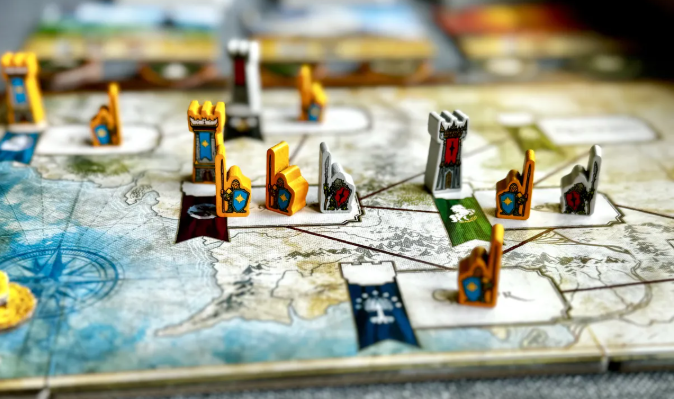
The map board is one of the biggest changes compared to other duel-style games I have played. Units can move between regions, and when opposing forces meet, they remove each other one by one until one side remains.
In practice, this system feels simple but meaningful. I often find myself deciding whether to push into a region now or wait for a better moment. Fortresses add another layer because they stay permanently in a region, which can make that area harder to take later.
A Familiar Card System
The card system will feel familiar if you have played 7 Wonders Duel. The game is played over three chapters, each with a display of cards arranged in layers. Some cards are visible, while others remain hidden until earlier cards are taken.
On my turn, I usually choose to build the card, discard it for coins, or use it to claim a landmark tile. The cards can do different things such as moving armies, advancing the ring track, or giving symbols that make future cards cheaper.
The chaining system is also here, and I always enjoy it when it happens. A well-timed chain can create a strong play without spending resources, and those moments feel very satisfying.
Gameplay Flow and Tension
What I really appreciate about the pacing is how quickly the game moves. Turns are simple and decisions are clear, but the consequences of those decisions can be huge.
Sometimes I pick a card just to stop my opponent from taking it. Other times I am trying to reveal hidden cards in a way that benefits me. That small layer of tactical thinking keeps every round interesting.
Who Will Enjoy This Game
From my experience, Duel for Middle-earth works well for players who enjoy two-player strategy games with meaningful decisions. It is not overly complex, but it still offers enough depth to stay interesting after multiple plays.
Fans of the Lord of the Rings theme will probably enjoy it even more because the story elements show up in small but satisfying ways. At the same time, you do not need to be a Tolkien expert to understand or enjoy the game.
Final Verdict
After several plays, I can honestly say Duel for Middle-earth is a game I am always happy to bring to the table. It is quick to set up, easy to learn, and consistently tense from start to finish.
For me, the biggest strength is how the three victory paths keep both players alert the entire time. No matter which strategy I pursue, I always feel like the game could turn in a single move. That constant tension makes every match feel exciting.